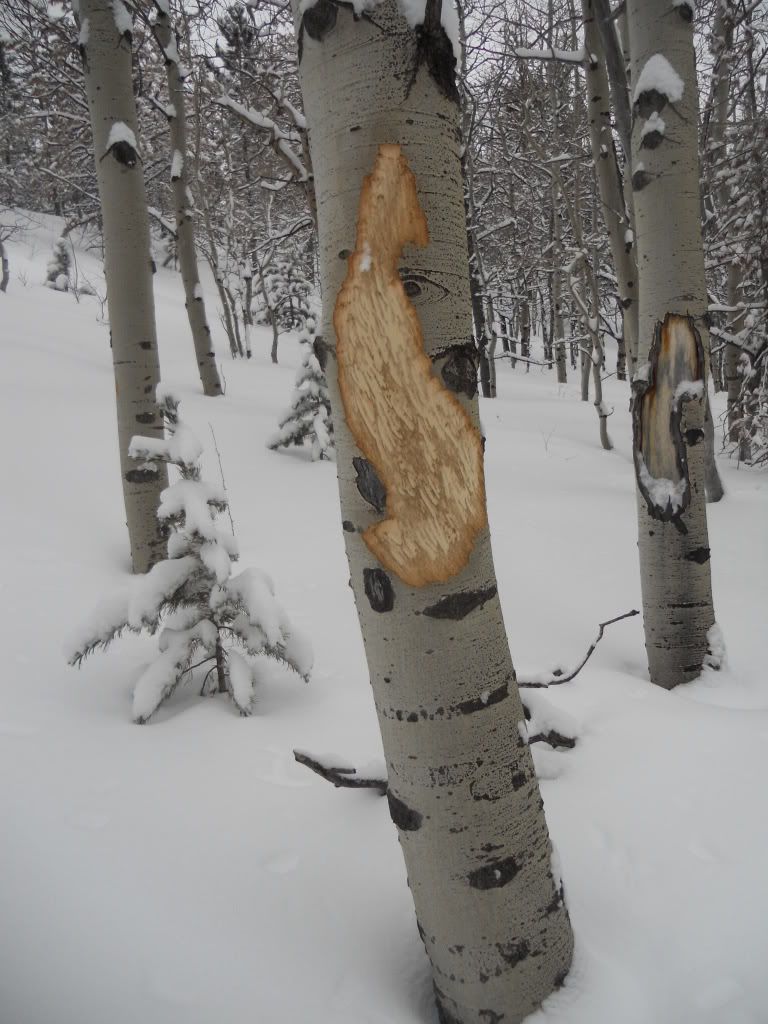
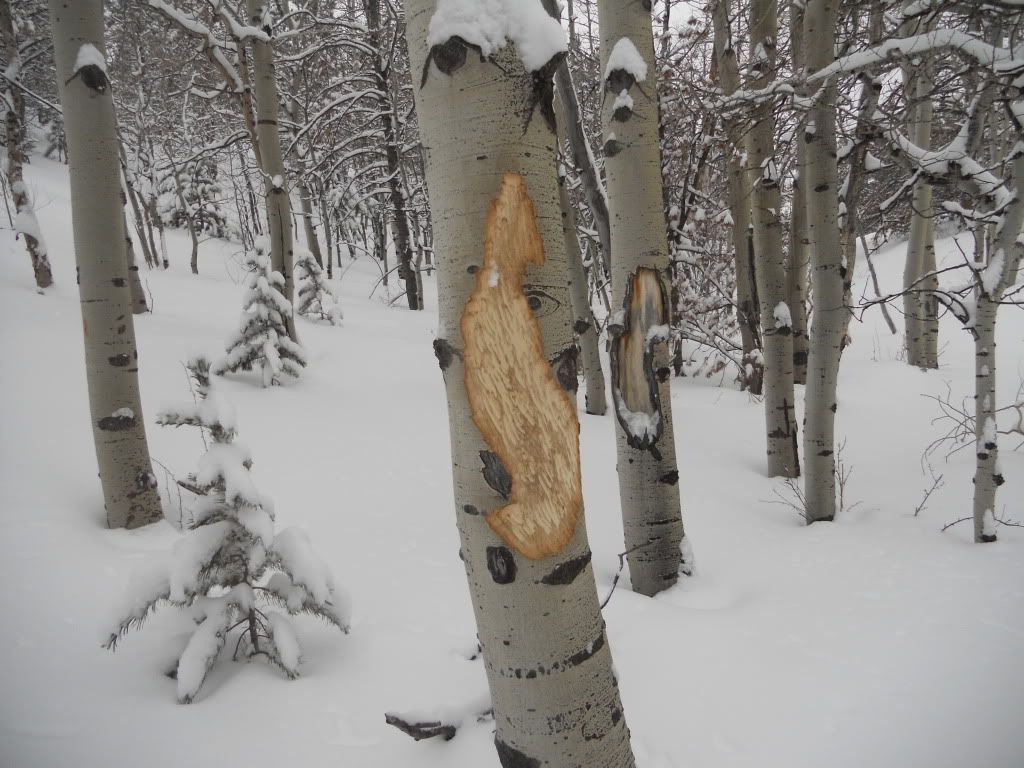
I've never seen anything like this before. doesn't look like deer or elk rub. Is it Lion or Bear? Notice the tree behind has a similar marking that is much older.
Looks like elk. You can see the teeth marks. Aspen bark is the main food source for elk during the winter. In most areas, you'll see most of the aspens are chewed on up to about 6 feet. The scare turns black after several years. So the bottom of all the aspens end up with black markings all around the bottom of the tree. Porcupines don't eat bark that low to the ground, all thier damage is up high. This could also be a horse chewing if it had been tied up there, but I've never seen any of our horses eat aspen bark.
Share
Dean Hendrickson
Pine, CO.
Rocky Mountain Wildlife Studios
rmwildlifestudios.com
I read the following on a website, and that is why I thought it may be a lion. I never considered elk eating the bark, but that seems to make the most sense. Found pictures on the web that seem to confirm that elk is what made this mark, although i hoped somebody would say that it is a big tom. i thought it interesting that they avoid the knots in the bark. Thanks guys.
Cougar Scratches
In addition to scat and urination for scent communication, cougars sometimes also leave scratch markings on tree trunks or stumps through a process called claw raking. Similar to a house cat scratching furniture, a cougar will stand on its hind legs and drag its claws down a tree trunk. The scratches will be approximately four to eight feet off the ground, depending on the size of the cat, and run parallel and vertically down the tree a few feet. Although these scrapes may simply be part of the claw-grooming process, many researchers believe it is another way for the cats to announce their presence. Scent from the paws is left behind in the tree bark and cougars have been observed sniffing the scratches made by other cats. Likely, it marks one's territory to deter intruders and serves as a dating bulletin board for those ready to mate.
Seeing scratched bark is not a clear indication of a cougar's presence. Bears also claw rake; their scrapes tend to be larger and remove more bark. Ungulates, like deer, elk and moose, rub their antlers against trees and can leave scratch marks, too. In preparation for rut (mating), it is common for males to scrape their antlers against tree trunks to help remove the velvet. Large mammals can also be seen rubbing their bodies against tree trunks to scratch those hard-to-reach itches.
I'm going to have to revise my guess and go with Catdogs. The only thing that didn't look right with elk is the large size of that area they chewed on and also, no other trees around there were marked. I never thought of moose until Catdogs mentioned it. I think he's right. Moose. That's why there is only one tree with the fresh scratching. If it were elk, it would probably have more trees in that area torn up.
Share
Dean Hendrickson
Pine, CO.
Rocky Mountain Wildlife Studios
rmwildlifestudios.com
It's moose, I have a few areas where I do my hunts and the trees are dead from them eating the bark.
I have watched them lots do it, they rake upward with their bottom teeth peeling it of with little effort.
i don't know what did it . but does any body else see that it looks like a coyote or a wolf sitting down with it's head pointed up howling at the moon . pretty cool .