I posted this in the past on another website.
Genealogical chart shows how line-breeding and inbreeding can be used to perpetuate and concentrate desirable genes. By mating sire named Frankie to dams A, B, C and D, then mating resulting half-brothers and half-sisters, 50% of genes passed on to offspring in the next two generations are Frankie's. Thus Frankie is, in effect, the sire of generations II, III and IV. If generation III were bred directly back to Frankie, then the genes passed on to generation IV, or current offspring, would be 75% Frankie's.
CURRENT OFFSPRING
Generation IV PARENTS
Generation III GRANDPARENTS
Generation II GREAT-GRANDPARENTS
Generation I
8/16 F + 2/16 A + 2/16 B + 2/16 C + 2/16 D 8/16 F + 4/16 A + 4/16 B 8/16 F + 8/16 A Frankie
A
half-brother to half-sister
8/16 F + 8/16 B Frankie
B
8/16 F + 4/16 C + 4/16 D 8/16 F + 8/16 C Frankie
C
half-brother to half-sister
8/16 F 4- 8/16 D Frankie
D
The most unusual commencement exercises in the country took place last week on a wooded campus in San Rafael, Calif. Eight of the graduates were dogs; but in their intelligence they seemed almost human. They were, in fact, byproducts of a study project in human behavior which used puppies as subjects for basic experiments. The findings on people are not yet in, but the project produced some radical discoveries about dogs that should be of great interest to every prospective pet owner. For example:
•All puppies of all breeds have mental capacities of almost zero until they are 21 days old.
•Inbreeding, usually considered a sure way to make idiots, actually can produce superdogs.
•The finest dogs in the world may become completely untrainable if they are left in the kennel beyond the age of 13 weeks.
•The best time to start training a dog is at 8 weeks, not 6 months as has always been supposed.
These and other discoveries were used as the foundation of a special program of breeding and training at Guide Dogs for the Blind Inc., where the eight dogs received their diplomas. This program, initiated by volunteer Director of Research Clarence J. Pfaffenberger, has proved so spectacularly successful that it may very well influence the future training and breeding of all dogs everywhere.
When Guide Dogs for the Blind was started in 1942, its founding members scouted the kennels of Europe and the U.S. to find the best possible animals for lead work. They settled on four common breeds—the German shepherd, the Labrador, the Chesapeake and the golden retriever. Within each breed, they then set out to choose the best individuals for the job. This proved difficult.
"We found that even among carefully screened adult dogs, bred and raised under normal dog-raising conditions," says Pfaffenberger, "seldom more than two out of 10 could be trained to our standard."
Refusing to accept such a poor success ratio, Pfaffenberger determined to find some means of testing dogs while they were still puppies, so that only those with the highest aptitudes would be kept for training.
He discussed the idea with people he met at American Kennel Club meetings, dog shows and field trials, but to his disappointment he found that the kind of tests he was interested in did not exist. Pfaffenberger then took his problem to Bar Harbor, Me., where a social psychologist and Rhodes scholar, Dr. J. Paul Scott, was directing a project aimed at understanding humans through a study of the behavior of dogs and other animals.
Dr. Scott proved more than helpful. In his studies he had uncovered a whole series of critical periods in the life of a puppy which directly affect the way he will behave as an adult. These critical periods apply to all breeds of dogs and fall into five categories:
1) Birth to the 21st day: During this period it is impossible to teach a puppy anything. His brain is like an electrical circuit without power. The puppy's only needs are food, warmth and his mother. Says Pfaffenberger, "This was basic knowledge about dogs which had not even been suspected through the thousands of years in which men and dogs have lived together."
First glimmer
2) The 21st to the 28th day: Abruptly on the 21st day the brain begins to function, and a puppy not only becomes capable of learning but will start to learn whether or not he is taught. During this fourth week a puppy must continue to have the absolute security of his mother; for at no other time in his life will emotional or social upsets (being left alone, frightened by loud noises, moved to a strange place) have as harmful or lasting effect.
3) The 28th to the 49th day: This is the time when a puppy starts to venture from his mother to investigate the world around him. Now he can learn to recognize his master, to respond to voices, to other animals and toys. The end of this period is the best time for a puppy to be weaned and taken to a new owner. Under no circumstances, however, should the puppy be weaned and then left in the kennel with his mother to wonder why he is not feeding as he did before.
4) The 49th to 84th day: At 7 weeks, although the pup is still physically immature, his brain has attained adult form. He can be taught to obey simple commands like sit, come, heel and fetch. But any training at this stage must be informal. The instruction periods must be brief, and there should be no punishment if the puppy fails to respond to a given command. For, during this period, what the puppy learns is not as important as the fact that he learns how to learn. This is also the time when the puppy begins forming his permanent attitudes toward people—those who feed, play with, teach or reprimand him. The kind of relationships he forms will affect his later acceptance of direction and education.
5) The 84th to 112th day: This is the final critical period, the time when the puppy is ready to declare his independence and man and dog decide who is boss. Informal play training must end here and serious adult training begin. However, the advanced training will be fully successful only if simple, informal training occurred earlier.
"Regardless of the inherited differences between breeds," says Dr. Scott, "all dogs, when given proper socialization from 3 weeks to 16 weeks of age, will reach a satisfactory level of behavior."
With Scott's critical periods as a foundation, Pfaffenberger set up a system of testing and training at Guide Dogs for the Blind. Although his program, described in technical detail in a recent booklet published by the American Kennel Club, has been worked out specifically for lead dogs, its broad outlines can easily be applied to all dogs.
Here is the Pfaffenberger formula: •From birth until 5 weeks of age—or during the first two critical periods plus an extra buffer week—a litter should remain with its mother in a small puppy room.
•At 5 weeks of age the pups are moved with their mother to a kennel, where they have access to an enclosed run. From the run they see other puppies and mothers, but until the 7th week contact with human beings is limited to the few kennel workers who clean the runs and bring food.
First training
•At 8 weeks the pups have their first extensive contact with people. One day a week each puppy is given 30 minutes of informal training. He is walked on a leash and shown how to sit, heel and come when called. Most important, he is taught to fetch a rubber ball rolled on the ground. This exercise, Pfaffenberger discovered, is particularly significant because it reveals much about a puppy's willingness to please. After the fetch test the dog is introduced to a succession of new people, new noises and new animals (such as cats), which he may meet in later life. Throughout this phase of training two observers rate each pup on his responses, scoring him from zero to five according to how quickly he learns, how playful or shy he may be and how well he reacts to each new situation he meets.
•At the end of the 12th week the pup gets his final exam, scored by a board of eight experts, who decide whether or not to keep the dog for lead training. For the exam, the pup is taken out on a simulated city block, complete with sidewalks, curbs and fire hydrant. He is walked on a leash along the street, past strolling people, past the hydrant and a tricycle or some other object deliberately left in his way. A potentially trainable dog will show definite interest in each of these situations and will not be frightened or bewildered by any of them. The ultimate test the puppy faces is to be confronted by a hand cart being pushed directly toward him. The cart comes right up to the puppy, passes by him, and stops. Then the puppy-is led back to the cart. This, like the earlier fetch test, is particularly important because it is almost certain to bring out any basic shyness, instability or indecisiveness in the dog.
After two years of testing and relating the test scores to success in later adult training, Pfaffenberger found that he was able to predict with reasonable accuracy which 12-week-old puppies had guide-dog potential and which did not. But still there was trouble. A large number of the puppies either failed the tests or passed with such low scores that they could not be kept for training. This meant either that the tests were too hard or that the average puppy being born at the Guide Dog kennels was simply not good enough to be trained for lead work.
Pfaffenberger talked to Scott and his colleagues again, and together they decided that it was probably the dogs which were at fault.
Since these dogs were among the finest of their breed anywhere in the world, the only way to improve them was to develop better strains within the existing stock—that is, to breed dogs which produced high-scoring puppies, and then breed only those puppies which rated highest on the tests. Because the high scorers frequently were in the same family this meant inbreeding and line-breeding—where brother is mated to sister, father to daughter, mother to son, etc.—a practice on which no two dog breeders have ever agreed. The scientists believed such breeding would concentrate and intensify desirable genes to produce superdogs—not canine Jukeses.
They were right. Beginning with a magnificent German shepherd named Frankie of Ledge Acres, and working along breeding lines set up by Frankie's owner, William F. Johns, executive director of Guide Dogs, the organization began producing a higher and higher percentage of trainable dogs. Although Frankie died two years ago, through a complex and carefully controlled system of line-breeding (worked out by Johns), his genes still make up [8/16], or 50% (see chart), of the inheritance of the majority of German shepherd litters born at the Guide Dog kennels.
Beyond these discoveries in training and breeding, the program at Guide Dogs for the Blind revealed one more significant factor in dog development. That is, no matter how carefully a dog is bred or how high he scores in puppy tests, he may turn out to be worthless for adult training if he is not made part of a family environment in close contact with people by the time he is 12 to 13 weeks old.
It is hard to believe," says Pfaffenberger, "that the potential of a superior puppy can be so reduced, but there is no question that many fine dogs of all types have been ruined by remaining too long in the isolation of a kennel."
Today 90% of the puppies bred at Guide Dogs for the Blind complete adult training and become lead dogs. Compared with an original 20% to 25% success ratio, such results mark an achievement without precedent. "Our results indicate that we often produce much better puppies than we ever realize," says Pfaffenberger. "There is no reason why comparable testing and breeding programs could not be applied with equal success to the improvement of all dogs, no matter what the purpose for which they are intended."
Genetic Diversity

Re: Genetic Diversity
im curious to know if hounds have identical twins ? and if so did they hunt the same?
Re: Genetic Diversity
Yes, you can have identical twins and whole litters that hunt similar but not the same. If you where to use one for breeding it would be the better of the two. I have seen some so close that the only way you would be able to tell which one is better is with a series of test over a period of time. I have seen whole litters that were close to being identical. When you see a litter like that the breeder knows what they are doing because it a sign that the genes are fixed inside and out.
JTG
JTG
kordog wrote:im curious to know if hounds have identical twins ? and if so did they hunt the same?
-
Jeff Eberle
- Open Mouth

- Posts: 724
- Joined: Thu Dec 25, 2008 6:35 pm
- Facebook ID: 0
- Location: Ione Ca.(209)
Re: Genetic Diversity
You can spend all day on the internet and come up with a truck load of pros & cons on line/inbreeding (just depends on who wrote it). Too many top dog the product of line/inbreeding for me to look any other way when breeding.
Last edited by Jeff Eberle on Mon Dec 15, 2014 2:22 am, edited 1 time in total.
Get JESUS In Your Life & Your Dog's In The Wood's
CLAVEY RIVER CUR'S
CLAVEY RIVER CUR'S
Re: Genetic Diversity
I think people need to look at line breeding less science lab and more backyard / real world to understand it. First every breed is the result of line breeding . In order to produce anything that's the same you have to start somewhere. So say you have ten different dogs and one does what you want very well and the rest have different levels of success. You would select the best animal AND breed it to the best member of the opposite sex Remember this first step because there's another method. OK so they produce a litter you will select those that best meet your needs now this is a basic best to best scenario. But if you breed these puppies to each other or ei5her parent your line breeding and have produced a basic breed. This what everyone who argues against line breeding forgets. The very fact that we recognize different breeds of livestock and races/ethnicities in humans shows that we recognize and appreciate breeding programs and their ability to produce individuals with identifiable characteristics.
Re: Genetic Diversity
So if you've bred best to best and it produced the great dogs you expected you by your own chosen method have to breed the resulting litter mates together (because best+best=better. The new best so you continue best+best ) that's line breeding or inbreeding more exactly.since there's no decision to breed back to one specific ancestor more then the others. So if best to best you have to either breed like that or decide to make a breeding to a inferior unrelated animal to escape line/inbreeding and also best to best or admit that best to best didn't produce better and you had to use a unrelated animal that was better then what you could produce with your best+best scenario. However if it did work and you continue to produce the best dogs out of the best +best breeding you have succeeded and are engaged in inbreeding. I hope that was clear enough and didn't have any science experiment vibe to scare people off in it. The only issue we have is blue ticks are used for so many types of game and conditions that when people start breeding their best suited dog to best in their eyes they may keep the color but are still basically creating a new breed in the breed. I'd rather keep a line pure and know what to expect from each litter then to go through the initial work of producing a new breed to breed true later anyway. If anyone wants to simplify the breeding method of selecting those two dogs that averages higher then the best to best opposite sex pair please do.
Re: Genetic Diversity
Maybe you guys could show crosses...... such as bro/sis...mom/son...fath/dau...??
IF IT SQUATS TO PEE, LET IT BE....
-
Jeff Eberle
- Open Mouth
- Posts: 724
- Joined: Thu Dec 25, 2008 6:35 pm
- Facebook ID: 0
- Location: Ione Ca.(209)
Re: Genetic Diversity
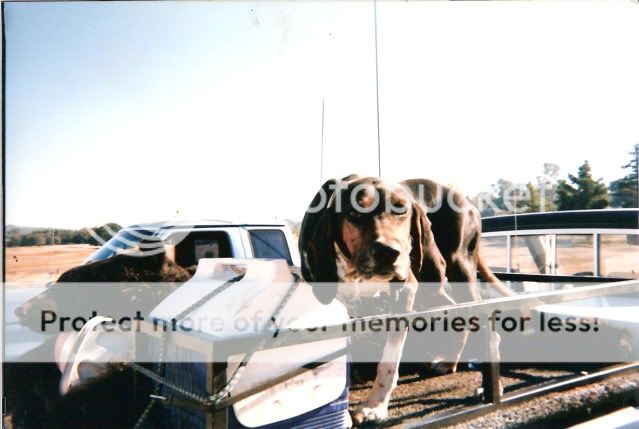
Here is Bonnie she was bred by Boone Shockly, I bought her from him at 4yrs old great Bobcat & Bear dog. Boone raised 4 females out of that Father / daughter cross all made top cat & bear dogs,
Get JESUS In Your Life & Your Dog's In The Wood's
CLAVEY RIVER CUR'S
CLAVEY RIVER CUR'S
-
BuckNAze
- Babble Mouth

- Posts: 1152
- Joined: Sun Feb 15, 2009 1:45 am
- Location: WA
- Facebook ID: 100004263486897
- Contact:
Re: Genetic Diversity
Keep this subject going. Been trying to learn more myself and dipped into linebreeding a little recently but want to know as much as I can. Pics are nice but video of pups out of your dogs you've linebreed on would be better. Want to know some success rates (%) on average people have had linebreeding/inbreeding, on pups that is turning out in each litter. I dont just mean mediocre dogs but does that were superstars or above average. Thanks
-
Dads dogboy

- Babble Mouth
- Posts: 1352
- Joined: Sat Mar 21, 2009 2:53 am
- Location: Arkansas
- Location: Central Arkansas
Re: Genetic Diversity
If you will go to the Search feature here on BGH and enter "Linebreeding" you should get several very good threads from the recent past with lots of references to give you some reading.
Click on the search button at the top of the page.
Type in "linebreeding Hounds" in the first line
then go to the lower part of the page and click on Topics rather than Posts
then in the final box click on the down arrow and highlight "All"
This should yield 39 Topics that will cover Line breeding Hounds as good as it can be done anywhere!
Click on the search button at the top of the page.
Type in "linebreeding Hounds" in the first line
then go to the lower part of the page and click on Topics rather than Posts
then in the final box click on the down arrow and highlight "All"
This should yield 39 Topics that will cover Line breeding Hounds as good as it can be done anywhere!
-
BuckNAze
- Babble Mouth
- Posts: 1152
- Joined: Sun Feb 15, 2009 1:45 am
- Location: WA
- Facebook ID: 100004263486897
- Contact:
Re: Genetic Diversity
Thanks Ive read most of them. Trying to find out about success of litters on average now and some pics and videos of those dogs on same game if anyone has some
-
Dads dogboy
- Babble Mouth
- Posts: 1352
- Joined: Sat Mar 21, 2009 2:53 am
- Location: Arkansas
- Location: Central Arkansas
Re: Genetic Diversity
All of our Hounds are HEAVILY line Bred! in the last 15 years have had to destroy 3 out of over 100 Pups. Of these two were directly related to Oxygen deprivation during the birthing process. The third went deaf after suffering from an attack of Tick fever (Erliccyiousis).
All of these Pups developed into USEABLE Hounds....some better than others....but all worth feeding (Some were just Pack Hounds in Glen's, Harold Parker's, and Our Packs; yet were top Hounds in others Packs).
You can go to my Posts and see these Hounds in Action or you are welcome to come see us any time, go hunting and talk Hounds with Dad. We have detailed records going back over 50 years!
I just saw that you are in WA, try to get to the Gathering in June. We will bring our Family Tree Chart, you and Dad can then talk Hounds, his program, and how it has worked!
All of these Pups developed into USEABLE Hounds....some better than others....but all worth feeding (Some were just Pack Hounds in Glen's, Harold Parker's, and Our Packs; yet were top Hounds in others Packs).
You can go to my Posts and see these Hounds in Action or you are welcome to come see us any time, go hunting and talk Hounds with Dad. We have detailed records going back over 50 years!
I just saw that you are in WA, try to get to the Gathering in June. We will bring our Family Tree Chart, you and Dad can then talk Hounds, his program, and how it has worked!
-
Goose
- Bawl Mouth

- Posts: 313
- Joined: Sun Apr 07, 2013 10:07 pm
- Location: Mississippi
- Facebook ID: 0
- Location: Southwest Mississippi (Gods Country)
Re: Genetic Diversity
But In a sense of breeding the best to the best aren't you in a way line breeding already this being said by only selecting a mate to breed your animal to based on what they can do and how they match your animals characteristics aren't you compounding the same genetics over and over this In theory is line breeding if breeding soley based on improvement of certain a strains of a breed
Re: Genetic Diversity
Best to the Best only works when the best to the best are related. If you breed best to the best when they are not related or slightly related your starting over with each breeding. When I say related I mean related over several generations of family breeding where the genes are already fixed. You will know when the genes are fixed when the offspring all look the same and the litter is hard to tell apart.
JTG
JTG
Goose wrote:But In a sense of breeding the best to the best aren't you in a way line breeding already this being said by only selecting a mate to breed your animal to based on what they can do and how they match your animals characteristics aren't you compounding the same genetics over and over this In theory is line breeding if breeding soley based on improvement of certain a strains of a breed